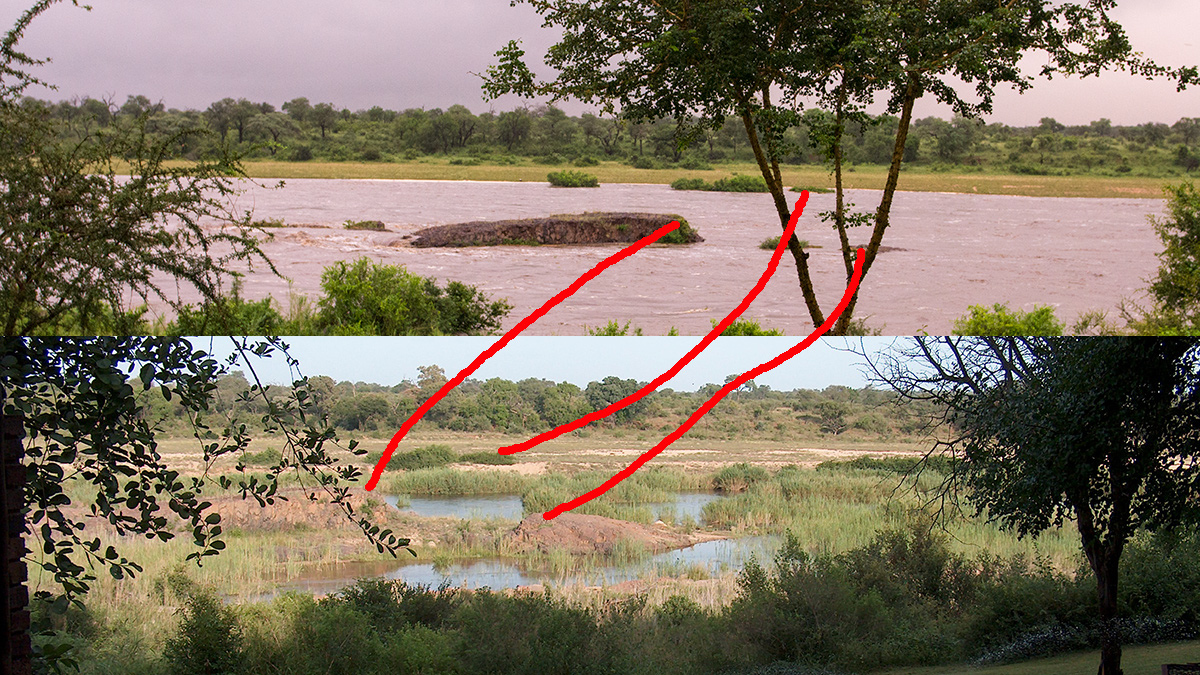
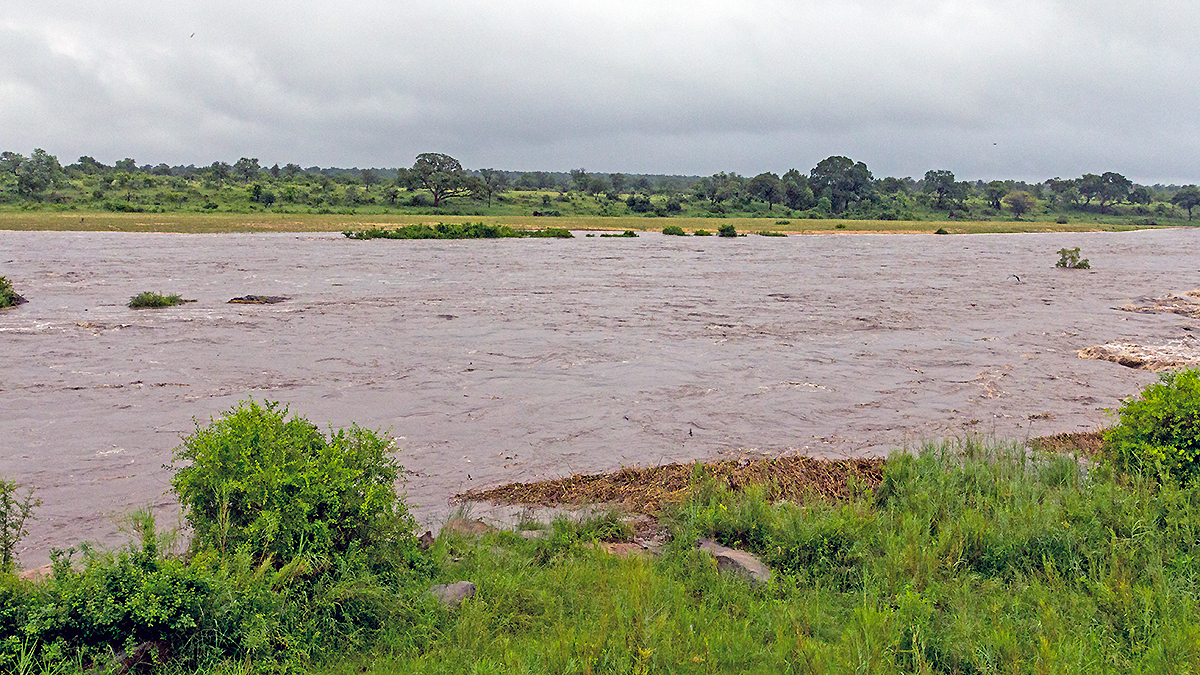
Atlasville, 20 Jan 2012
We arrived at Ngwenya on Friday, 13th January (is this an ill omen?) to take up our annual timeshare week knowing that a tropical cyclone out in the Indian Ocean would have an impact on our weather in the coming days, but there was still uncertainty as to what extent this would affect us.
Heading into Kruger Park on Saturday 14th, as usual via Crocodile Bridge Gate, we had overcast skies after a bit of overnight rain. In gloomy conditions any bird photography would have to wait until later in the day, when sunny skies were forecast. So, we decided to head straight for Lower Sabie and onward to Satara, hoping that the sun would come out and give us a better return leg.
We were halted by a roadblock of the four-legged kind on the Nhlowa Road just before the Nthandanyathi Bird Hide as a herd of elephants crossed ahead of us. Right next to the parking area at the bird hide we found a large herd of impala. As for birds, nothing to be seen. The first bird photo of the day was much later, on the main tar road north of Lower Sabie, where it runs parallel with Muntshe hill. This was a dark form Wahlberg’s Eagle in an Apple Leaf tree.
The only other stop before Satara was at the Mazithi Dam north of Tshokwane. Normally we would have been jostling other vehicles for a fleeting glimpse if were lucky, but today we were the ones who first located the pride of lion lying in the grass, a large pride with one battle-scarred male, 3 or 4 females and as many young cubs. Bathing in the dam was a solitary bull elephant. Most obvious bird in the trees across the road from the dam was a brilliant purple male Violet-backed Starling.
Although the sun did emerge for our drive back south, we had not really factored in the very lush state of the vegetation after what has so far been a very wet summer, so we had no more luck in the afternoon than in the cloudy conditions earlier. The only bird photographs were of an immature Lesser Spotted Eagle atop a dead tree on the Mativuhlungu Loop south of Lower Sabie.
A disappointing birding day, rescued by having a pride of lion all to ourselves.
![African Bush Elephant [Loxodonta africana]](https://neilswildlifejournal.uk/wp-content/gallery/mammals-the-big-5/JO8V9467_EOS-1D_NhlowaRoad_14Jan2012.jpg "African Bush Elephant [Loxodonta africana]")
![African Bush Elephant [Loxodonta africana]](https://neilswildlifejournal.uk/wp-content/gallery/mammals-the-big-5/JO8V9437_EOS-1D_NhlowaRoad_14Jan2012.jpg "African Bush Elephant [Loxodonta africana]")
![Impala [Aepyceros melampus melampus]](https://neilswildlifejournal.uk/wp-content/gallery/ungulates/JO8V9479_EOS-1D_Nthandanyathi_14Jan2012.jpg "Impala [Aepyceros melampus melampus]")
![Wahlberg's Eagle [Hieraaetus wahlbergi]](https://neilswildlifejournal.uk/wp-content/gallery/post-images-2012/CN8E2142_EOS-1D_nrMuntshe_120114.jpg "Wahlberg's Eagle [Hieraaetus wahlbergi]")
![Lion [Panthera leo melanochaita]](https://neilswildlifejournal.uk/wp-content/gallery/mammals-the-big-5/CN8E2198_EOS-1D_Mazithi_14Jan2012.jpg "Lion [Panthera leo melanochaita]")
![Lion [Panthera leo melanochaita]](https://neilswildlifejournal.uk/wp-content/gallery/mammals-the-big-5/CN8E2182_EOS-1D_Mazithi_14Jan2012.jpg "Lion [Panthera leo melanochaita]")
![African Bush Elephant [Loxodonta africana]](https://neilswildlifejournal.uk/wp-content/gallery/mammals-the-big-5/CN8E2151_EOS-1D_Mazithi_14Jan2012.jpg "African Bush Elephant [Loxodonta africana]")
![Violet-backed Starling [Cinnyricinclus leucogaster verreauxi]](https://neilswildlifejournal.uk/wp-content/gallery/polioptilidae-sittidae-certhiidae-mimidae-sturnidae-buphagidae/CN8E2193_EOS-1D_Mazithi_120114.jpg "Violet-backed Starling [Cinnyricinclus leucogaster verreauxi]")
![Lesser Spotted Eagle [Clanga pomarina?]](https://neilswildlifejournal.uk/wp-content/gallery/accipitriformes/CN8E2208_EOS-1D_MativuhlunguLoop_120114.jpg "Lesser Spotted Eagle [Clanga pomarina?]")
![Lesser Spotted Eagle [Clanga pomarina?]](https://neilswildlifejournal.uk/wp-content/gallery/accipitriformes/CN8E2207_EOS-1D_MativuhlunguLoop_120114.jpg "Lesser Spotted Eagle [Clanga pomarina?]")
There was more rain overnight, so on Sunday 15th we headed into the Park in heavily overcast conditions again. Today we took the Randspruit Road (which largely follows an old railway line, the tracks and sleepers of which have long since been removed) towards Skukuza. Almost immediately we were stopped by an animal in the middle of the road, only ever seen before many years ago on a night drive, a Scrub Hare. A largely nocturnal animal, it will remain out foraging past dawn on very overcast days like today. We even got a chink of sunlight to give a better photo.
We always call in at the Lake Panic Hide near Skukuza. No matter what the weather, there is always something to be seen here. On the access road we had a Martial Eagle on a distant treetop. The first three photos from the hide were all of kingfishers, Malachite Kingfisher, Pied Kingfisher and Woodland Kingfisher. Many of the usual cast were there, Wire-tailed Swallow, Goliath Heron, Village Weaver, Western Cattle Egret and Great Egret. Today the African Jacana had competition in their lily-trotting with a juvenile Black Crake.
There are several large, spreading Sycamore Fig Tree (Ficus sycomorus) on the bank of the Sabie River outside the restaurant at Skukuza rest camp. Today they hosted African Green Pigeon and Purple-crested Turaco, while Tawny-flanked Prinia and Red-faced Cisticola could be found in the bushes beneath. Sadly, the light just wasn’t conducive to good photos.
Later, on the Mlondozi Road north of Lower Sabie we encountered a rather damp Secretarybird, probably from walking through wet long grass all day. Nearby was a Cape Starling that had made a catch and sat on a branch with it in its beak. Zooming in on processing the image, I was able to see that its catch is a solifuge, a spider-like arachnid, this one probably a Pale Moon Spider (Zeria monteiri). Despite its name it is not a true spider.
Sunset Dam at Lower Sabie added African Spoonbill, African Openbill, Wood Sandpiper, Ruff and Three-banded Plover, among others, to our list.
Back at Ngwenya, a Kurrichane Thrush probed for worms on the grass outside our chalet.
![Scrub Hare [Lepus saxatilis]](https://neilswildlifejournal.uk/wp-content/gallery/other-mammals/JO8V9485_EOS-1D_RandspruitRoad_15Jan2012.jpg "Scrub Hare [Lepus saxatilis]")
![Malachite Kingfisher [Corythornis cristatus cristatus]](https://neilswildlifejournal.uk/wp-content/gallery/post-images-2012/CN8E2213_EOS-1D_LakePanic_120115.jpg "Malachite Kingfisher [Corythornis cristatus cristatus]")
![Pied Kingfisher [Ceryle rudis rudis]](https://neilswildlifejournal.uk/wp-content/gallery/post-images-2012/CN8E2214_EOS-1D_LakePanic_120115.jpg "Pied Kingfisher [Ceryle rudis rudis]")
![Woodland Kingfisher [Halcyon senegalensis cyanoleuca]](https://neilswildlifejournal.uk/wp-content/gallery/post-images-2012/CN8E2215_EOS-1D_LakePanic_120115.jpg "Woodland Kingfisher [Halcyon senegalensis cyanoleuca]")
![Great Egret [Ardea alba melanorhynchos]](https://neilswildlifejournal.uk/wp-content/gallery/pelecaniformes-opisthocomiformes/CN8E2218_EOS-1D_LakePanic_120115.jpg "Great Egret [Ardea alba melanorhynchos]")
![Black Crake [Zapornia flavirostra]](https://neilswildlifejournal.uk/wp-content/gallery/post-images-2012/JO8V9486_EOS-1D_LakePanic_120115.jpg "Black Crake [Zapornia flavirostra]")
![Secretarybird [Sagittarius serpentarius]](https://neilswildlifejournal.uk/wp-content/gallery/accipitriformes/CN8E2225_EOS-1D_nrMlondoziDam_120115.jpg "Secretarybird [Sagittarius serpentarius]")
![Cape Starling [Lamprotornis nitens]](https://neilswildlifejournal.uk/wp-content/gallery/post-images-2012/CN8E2234_EOS-1D_MlondoziRoad_120115.jpg "Cape Starling [Lamprotornis nitens]")
![Pale Moon Spider [Zeria monteiri?]](https://neilswildlifejournal.uk/wp-content/gallery/post-images-2012/CN8E2234a_EOS-1D_MlondoziRoad_120115.jpg "Pale Moon Spider [Zeria monteiri?]")
![Kurrichane Thrush [Turdus libonyana libonyana]](https://neilswildlifejournal.uk/wp-content/gallery/post-images-2012/JO8V9497_EOS-1D_Ngwenya_120115.jpg "Kurrichane Thrush [Turdus libonyana libonyana]")
Yet more overnight rain and we could see that the level of the Crocodile River outside had risen, but not yet an issue for accessing the Park via the causeway at Crocodile Bridge. We set off again on Monday 16th under heavy skies, sticking mainly to the tar roads to Lower Sabie, then on via Skukuza to Paul Kruger Gate.
At Lower Sabie we saw Giant Kingfisher on the causeway and Yellow-billed Stork at Sunset Dam. At Skukuza we added White-throated Swallow, and by the time we reached Lake Panic Hide the sun was just starting to break through the clouds. I managed some shots of Village Weaver, Lesser Masked Weaver and a Goliath Heron with two juveniles, the first time I had seen juveniles of this heron.
The cloud closed in again as we got to Paul Kruger Gate, but we took the S3 gravel road that runs along the Sabie River to near the Phabeni Gate. There were no more photos, but we added European Bee-eater, Chinspot Batis, Black-backed Puffback, Black-headed Oriole and Southern Black Flycatcher, among others. There were a few places where the road was under water, and these had to be negotiated with care. You never know what is under muddy water and in Kruger Park you can’t get out of your vehicle to check. Reaching the end of the gravel road and back onto tar we immediately spotted a Brown-headed Parrot and shortly afterwards a Tawny Eagle, but then the heavens opened again.
We decided just to head back to Ngwenya, effectively retracing our steps from Skukuza to Crocodile Bridge, sticking largely to tar roads.
![Giant Kingfisher [Megaceryle maxima]](https://neilswildlifejournal.uk/wp-content/gallery/post-images-2012/IMG_0186_60D_LowerSabieWeir_120116.jpg "Giant Kingfisher [Megaceryle maxima]")
![Yellow-billed Stork [Mycteria ibis]](https://neilswildlifejournal.uk/wp-content/gallery/post-images-2012/JO8V9498_EOS-1D_SunsetDam_120116.jpg "Yellow-billed Stork [Mycteria ibis]")
![White-throated Swallow [Hirundo albigularis]](https://neilswildlifejournal.uk/wp-content/gallery/pycnonotidae-hirundinidae/CN8E2330_EOS-1D_nrSkukuza_120116.jpg "White-throated Swallow [Hirundo albigularis]")
![Village Weaver [Ploceus cucullatus spilonotus]](https://neilswildlifejournal.uk/wp-content/gallery/passeridae-ploceidae/CN8E2239_EOS-1D_LakePanic_120116.jpg "Village Weaver [Ploceus cucullatus spilonotus]")
![Village Weaver [Ploceus cucullatus spilonotus]](https://neilswildlifejournal.uk/wp-content/gallery/passeridae-ploceidae/CN8E2254_EOS-1D_LakePanic_120116.jpg "Village Weaver [Ploceus cucullatus spilonotus]")
![Lesser Masked Weaver [Ploceus intermedius cabanisii]](https://neilswildlifejournal.uk/wp-content/gallery/post-images-2012/CN8E2248_EOS-1D_LakePanic_120116.jpg "Lesser Masked Weaver [Ploceus intermedius cabanisii]")
![Goliath Heron [Ardea goliath]](https://neilswildlifejournal.uk/wp-content/gallery/pelecaniformes-opisthocomiformes/CN8E2259_EOS-1D_LakePanic_120116.jpg "Goliath Heron [Ardea goliath]")
![Goliath Heron [Ardea goliath]](https://neilswildlifejournal.uk/wp-content/gallery/pelecaniformes-opisthocomiformes/CN8E2281_EOS-1D_LakePanic_120116.jpg "Goliath Heron [Ardea goliath]")
![Brown-headed Parrot [Poicephalus cryptoxanthus cryptoxanthus]](https://neilswildlifejournal.uk/wp-content/gallery/psittaciformes/CN8E2305_EOS-1D_S3nrPhabeni_120116.jpg "Brown-headed Parrot [Poicephalus cryptoxanthus cryptoxanthus]")
![Tawny Eagle [Aquila rapax rapax]](https://neilswildlifejournal.uk/wp-content/gallery/post-images-2012/CN8E2328_EOS-1D_DoispaneRoad_120116.jpg "Tawny Eagle [Aquila rapax rapax]")
It continued to rain almost non-stop and was still raining as we rose just before dawn on Tuesday 17th. I made a dash in the rain to the main bird hide, only 50m from our chalet, and ticked off 20 species even in the atrocious conditions.
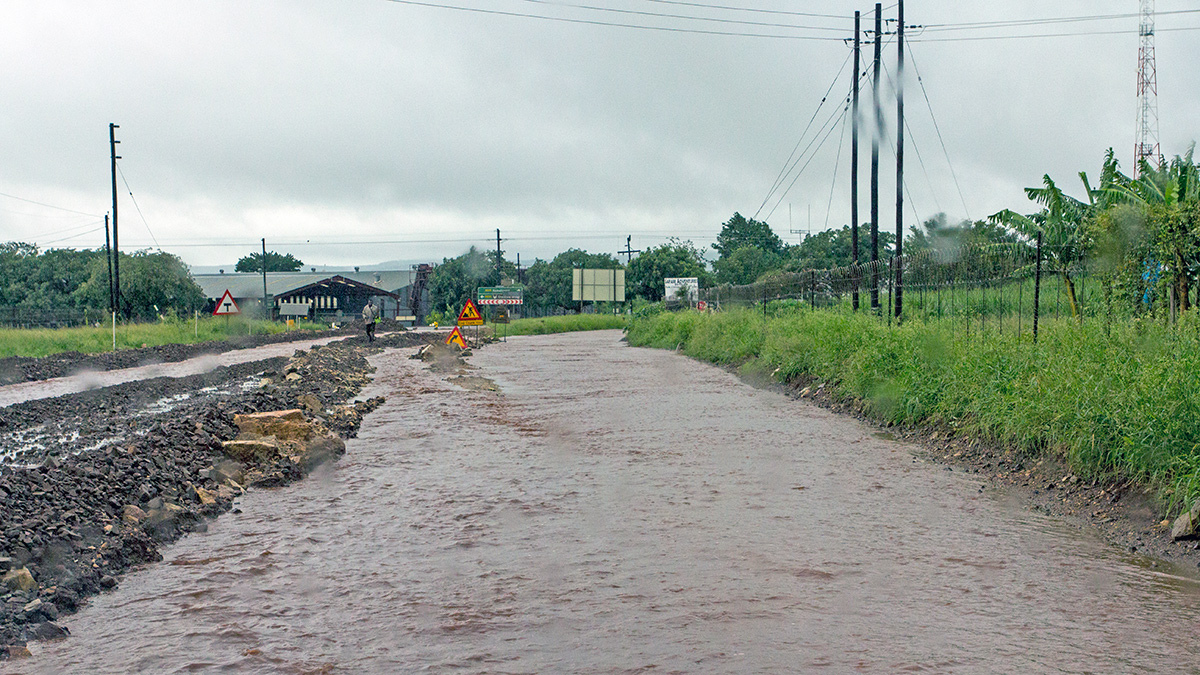
The rain stopped about 90 minutes after sunrise, not that we could see the sun, so we left Ngwenya to be confronted by the gravel road to Crocodile Bridge under water in several places. The Parks Board had closed some of the gravel roads, so making the assumption that those they hadn’t closed must be fit for travel, we decided to head up through Lower Sabie towards Tshokwane, take the Muntshe Loop and return, staying on roads that we had already used on the previous days. We’d be back at Ngwenya for a late lunch.
Some highlights of the morning were a very bedraggled Bronze-winged Courser standing forlornly beside a puddle as the rain came down yet again, a pair of Knob-billed Duck and a grazing White Rhinoceros, quite oblivious to the rain.
The surprise of the morning came close to the northern end of the Gomondwane Loop, where a small waterhole that in previous years has been no more than a muddy puddle was close to overflowing. It was also populated by noisy Giant African Bullfrog. This is one of the ‘Big 6’ of anurans (frogs and toads) worldwide. Males weigh up to 1.4 kg and grow to 25 cm in length. They remain dormant underground for up to 2 years waiting for conditions like today to emerge and mate – very noisily.
![Bronze-winged Courser [Rhinoptilus chalcopterus]](https://neilswildlifejournal.uk/wp-content/gallery/charadriiformes-1/CN8E2337_EOS-1D_NhlowaRoad_120117.jpg "Bronze-winged Courser [Rhinoptilus chalcopterus]")
![Knob-billed Duck [Sarkidiornis melanotos]](https://neilswildlifejournal.uk/wp-content/gallery/anseriformes/CN8E2382_EOS-1D_NhlowaRoad_120117.jpg "Knob-billed Duck [Sarkidiornis melanotos]")
![White Rhinoceros [Ceratotherium simum simum] ]](https://neilswildlifejournal.uk/wp-content/gallery/mammals-the-big-5/CN8E2383_EOS-1D_NhlowaRoad_17Jan2012.jpg "White Rhinoceros [Ceratotherium simum simum] ]")
![Giant African Bullfrog [Pyxicephalus adspersus]](https://neilswildlifejournal.uk/wp-content/gallery/amphibians-fish-jellyfish-molluscs/CN8E2351_EOS-1D_GomondwaneLoop_120117.jpg "Giant African Bullfrog [Pyxicephalus adspersus]")
![Giant African Bullfrog [Pyxicephalus adspersus]](https://neilswildlifejournal.uk/wp-content/gallery/amphibians-fish-jellyfish-molluscs/CN8E2359_EOS-1D_GomondwaneLoop_120117.jpg "Giant African Bullfrog [Pyxicephalus adspersus]")
![Giant African Bullfrog [Pyxicephalus adspersus]](https://neilswildlifejournal.uk/wp-content/gallery/amphibians-fish-jellyfish-molluscs/CN8E2373_EOS-1D_GomondwaneLoop_120117.jpg "Giant African Bullfrog [Pyxicephalus adspersus]")
We arose on Wednesday 18th to find the Crocodile River at the highest level we have ever seen it. Crocodile Bridge Gate would definitely be closed. It was still raining intermittently so it was to be a day of reading for my wife, while I dodged the rain with my binoculars seeing what I could find around the extensive grounds of Ngwenya. I wasn’t going to risk my Canon equipment in what was occasionally torrential rain. Amazingly I tallied 45 species even in those conditions.
[P.S. The unprecedented flooding Kruger Park-wide in January 2026, labelled a ‘1-500 year event’, caused severe damage to the Park infrastructure. In the image I posted showing the level of the Crocodile River, had this been January 2026 I would have been up to my knees in water shooting the image, and the water on the far bank in the Kruger Park would be finding its way into the woodland.]
We headed home a day early, the first time since 1998, when we began coming to Ngwenya during this week in January, that ‘rain stopped play’.
It was nevertheless an interesting (short) week as I still, despite the weather, finished with a bird trip list of 163 species. Then there were the Scrub Hare and the Giant African Bullfrog, as well as a pride of lion all to ourselves. These are the things that make you come back time and time again.