
Santiago, 15 Apr 2012
Since I posted my last report, I have experienced a magnitude 7.1 earthquake. It happened at 7:30 p.m. on March 25th, 3 weeks ago today. The quake was centred near Constitución and Talca, roughly 220 km south of Santiago, at a depth of about 35–40 km, causing significant damage in that area. The effect here in Santiago was to cause widespread swaying of buildings. I live on the 8th floor of my building, and I certainly felt the movement. Looking across the street to the building opposite it seemed that I was moving to my left and the building opposite was moving right. A truly eerie and scary moment.
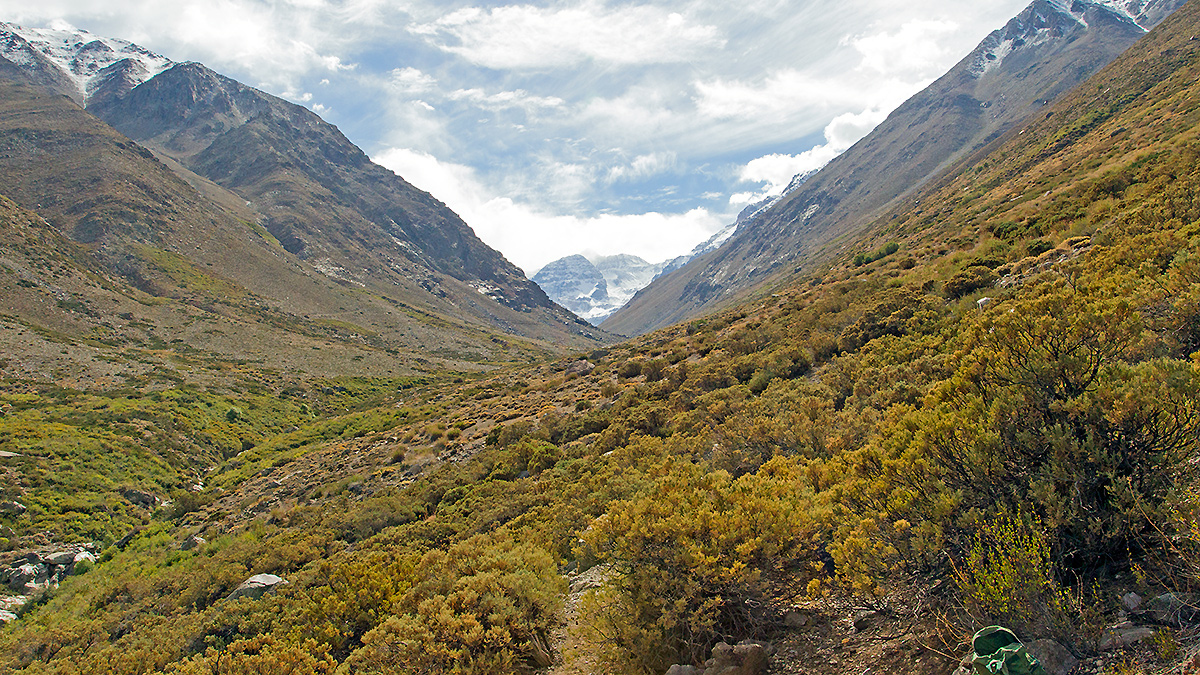
At least I am still here to post my latest trip report. Today I drove to the Yerba Loca Nature Sanctuary, a 33 km drive to the east up into the Andes. The entrance to the reserve (point 2 on map) sits at an elevation of 1,750 m. After paying my entrance fee I then drove a further 4 km into the reserve, to the car park at the start of the walking trails, birding as I went. The car park is at an elevation of 1,925 m and the walking trails head up the valley from there. The furthest point that I reached (point 4 on map), after a 3.3km walk, was at 2,335 m. The trail has an average gradient of 1:8, and it’s all up. The best part, of course, is that it is all downhill on the way back.
It was not a long list of birds seen and I managed to photograph many of them. They were Moustached Turca (endemic), Rufous-collared Sparrow, Austral Blackbird, Austral Thrush, Diuca Finch, Mourning Sierra Finch, Long-tailed Meadowlark, Rufous-tailed Plantcutter, Harris’s Hawk, Austral Pygmy Owl, Chilean Tinamou (near-endemic), Buff-winged Cinclodes, Dark-bellied Cinclodes, Rufous-banded Miner and Chilean Mockingbird.
![Moustached Turca [Pteroptochos megapodius megapodius]](https://neilswildlifejournal.uk/wp-content/gallery/pittidae-furnariidae-thamnophilidae-formicariidae-grallariidae-conopophagidae-rhinocryptidae/CN8E3453_EOS-1D_FarellonesCurvas_15Apr2012.jpg "Moustached Turca [Pteroptochos megapodius megapodius]")
![Rufous-collared Sparrow [Zonotrichia capensis chilensis]](https://neilswildlifejournal.uk/wp-content/gallery/motacillidae-fringillidae-emberizidae-passerellidae/CN8E3471_EOS-1D_YerbaLoca_15Apr2012.jpg "Rufous-collared Sparrow [Zonotrichia capensis chilensis]")
![Austral Blackbird [Curaeus curaeus curaeus]](https://neilswildlifejournal.uk/wp-content/gallery/zeledoniidae-icteridae-parulidae-cardinalidae/CN8E3475_EOS-1D_YerbaLoca_15Apr2012.jpg "Austral Blackbird [Curaeus curaeus curaeus]")
![Diuca Finch [Diuca diuca diuca]](https://neilswildlifejournal.uk/wp-content/gallery/thraupidae/CN8E3485_EOS-1D_YerbaLoca_15Apr2012.jpg "Diuca Finch [Diuca diuca diuca]")
![Diuca Finch [Diuca diuca diuca]](https://neilswildlifejournal.uk/wp-content/gallery/thraupidae/CN8E3489_EOS-1D_YerbaLoca_15Apr2012.jpg "Diuca Finch [Diuca diuca diuca]")
![Mourning Sierra Finch [Rhopospina fruticeti fruticeti]](https://neilswildlifejournal.uk/wp-content/gallery/thraupidae/CN8E3529_EOS-1D_YerbaLoca_15Apr2012.jpg "Mourning Sierra Finch [Rhopospina fruticeti fruticeti]")
![Long-tailed Meadowlark [Leistes loyca loyca]](https://neilswildlifejournal.uk/wp-content/gallery/zeledoniidae-icteridae-parulidae-cardinalidae/CN8E3548_EOS-1D_YerbaLoca_15Apr2012.jpg "Long-tailed Meadowlark [Leistes loyca loyca]")
![Harris's Hawk [Parabuteo unicinctus unicinctus]](https://neilswildlifejournal.uk/wp-content/gallery/accipitriformes/CN8E3561_EOS-1D_YerbaLoca_15Apr2012.jpg "Harris's Hawk [Parabuteo unicinctus unicinctus]")
![Austral Pygmy Owl [Glaucidium nana]](https://neilswildlifejournal.uk/wp-content/gallery/strigiformes/CN8E3653_EOS-1D_YerbaLoca_15Apr2012.jpg "Austral Pygmy Owl [Glaucidium nana]")
![Chilean Tinamou [Nothoprocta perdicaria perdicaria]](https://neilswildlifejournal.uk/wp-content/gallery/struthioniformes-rheiformes-casuariformes-tinamiformes/CN8E3463_EOS-1D_FarellonesCurvas_15Apr2012.jpg "Chilean Tinamou [Nothoprocta perdicaria perdicaria]")
![Dark-bellied Cinclodes [Cinclodes patagonicus chilensis]](https://neilswildlifejournal.uk/wp-content/gallery/pittidae-furnariidae-thamnophilidae-formicariidae-grallariidae-conopophagidae-rhinocryptidae/CN8E3593_EOS-1D_YerbaLoca_15Apr2012.jpg "Dark-bellied Cinclodes [Cinclodes patagonicus chilensis]")
![Chilean Mockingbird [Mimus thenca]](https://neilswildlifejournal.uk/wp-content/gallery/post-images-2012/CN8E3447_EOS-1D_FarellonesCurvas_120415.jpg "Chilean Mockingbird [Mimus thenca]")
![Chilean Mockingbird [Mimus thenca]](https://neilswildlifejournal.uk/wp-content/gallery/post-images-2012/CN8E3500_EOS-1D_YerbaLoca_120415.jpg "Chilean Mockingbird [Mimus thenca]")
The Austral Pygmy Owl is a diurnal hunter. The one in the image above has caught a Common Degu, probably a juvenile. The degu is a diurnally active rodent related to guinea pigs and chinchillas that forms a large part of the diet of the pygmy owl.
I was also fortunate to see a Chilean Short-tailed Snake (a.k.a. Chilean Slender Snake). Many of the Chileans working with me have never seen one. It is one of only two widespread snake species in Chile, another four being very localised in arid, high-altitude areas of the far north of the country.
![Common Degu [Octodon degus]](https://neilswildlifejournal.uk/wp-content/gallery/post-images-2012/CN8E3651_EOS-1D_YerbaLoca_15Apr2012.jpg "Common Degu [Octodon degus]")
![Chilean Short-tailed Snake [Galvarinus chilensis]](https://neilswildlifejournal.uk/wp-content/gallery/reptiles/CN8E3625_EOS-1D_YerbaLoca_15Apr2012.jpg "Chilean Short-tailed Snake [Galvarinus chilensis]")