
Atlasville, 18 Aug 2009
Arriving back in Guinea on 2nd July, I stayed overnight in Conakry, right on the coast, and picked up a couple of lifers with Western Reef Heron and Black Tern, while Hooded Vulture seemed very common in the urban area.
![Western Reef Heron [Egretta gularis gularis]](https://neilswildlifejournal.uk/wp-content/gallery/pelecaniformes-opisthocomiformes/MG_5840_20D_Conakry_02Jul2009.jpg "Western Reef Heron [Egretta gularis gularis]")
![Hooded Vulture [Necrosyrtes monachus]](https://neilswildlifejournal.uk/wp-content/gallery/accipitriformes/MG_5827_20D_Conakry_02Jul2009.jpg "Hooded Vulture [Necrosyrtes monachus]")
![Hooded Vulture [Necrosyrtes monachus]](https://neilswildlifejournal.uk/wp-content/gallery/accipitriformes/MG_5831_20D_Conakry_02Jul2009.jpg "Hooded Vulture [Necrosyrtes monachus]")
Arriving next morning at Gbenko airfield I added Little Swift and Northern Fiscal before the drive to Kérouané, my base for the next 4 weeks. My birdwatching was confined to the grounds of our base and what I could manage at 20-50 kph while travelling out daily to the project site.
In Kérouané I added Northern Grey-headed Sparrow, Bronze Mannikin, Yellow-throated Longclaw, Splendid Sunbird, Ayres’s Hawk-Eagle, Red-billed Firefinch, Red-chested Swallow, West African Swallow (now regarded as a sub-species of African Red-rumped Swallow), African Palm Swift, Red-throated Rock Martin and Diederik Cuckoo. Other ‘wildlife’ in the grounds of the Kérouané house were West African Rainbow Lizard, a giant dung beetle (probably a Heliocopris sp.), a Pink Giant African Emperor Moth and a Rock Bush Brown butterfly.
![Northern Grey-headed Sparrow [Passer griseus griseus]](https://neilswildlifejournal.uk/wp-content/gallery/passeridae-ploceidae/MG_5860_20D_Kerouane_04Jul2009.jpg "Northern Grey-headed Sparrow [Passer griseus griseus]")
![Northern Grey-headed Sparrow [Passer griseus griseus]](https://neilswildlifejournal.uk/wp-content/gallery/passeridae-ploceidae/MG_5857_20D_Kerouane_04Jul2009.jpg "Northern Grey-headed Sparrow [Passer griseus griseus]")
![Bronze Mannikin [Spermestes cucullata cucullata]](https://neilswildlifejournal.uk/wp-content/gallery/post-images-2009-2010/MG_5904_20D_Kerouane_11Jul2009.jpg "Bronze Mannikin [Spermestes cucullata cucullata]")
![Bronze Mannikin [Spermestes cucullata cucullata]](https://neilswildlifejournal.uk/wp-content/gallery/post-images-2009-2010/MG_5900_20D_Kerouane_11Jul2009.jpg "Bronze Mannikin [Spermestes cucullata cucullata]")
![Bronze Mannikin [Spermestes cucullata cucullata]](https://neilswildlifejournal.uk/wp-content/gallery/post-images-2009-2010/MG_5885_20D_Kerouane_08Jul2009.jpg "Bronze Mannikin [Spermestes cucullata cucullata]")
![Yellow-throated Longclaw [Macronyx croceus croceus]](https://neilswildlifejournal.uk/wp-content/gallery/post-images-2009-2010/MG_5922_20D_Kerouane_12Jul2009.jpg "Yellow-throated Longclaw [Macronyx croceus croceus]")
![Splendid Sunbird [Cinnyris coccinigastrus]](https://neilswildlifejournal.uk/wp-content/gallery/post-images-2009-2010/MG_5929_20D_Kerouane_12Jul2009.jpg "Splendid Sunbird [Cinnyris coccinigastrus]")
![Ayres's Hawk-Eagle [Hieraaetus ayresii]](https://neilswildlifejournal.uk/wp-content/gallery/post-images-2009-2010/MG_6028_20D_Kerouane_25Jul2009.jpg "Ayres's Hawk-Eagle [Hieraaetus ayresii]")
![Red-billed Firefinch [Lagonosticta senegala senegala]](https://neilswildlifejournal.uk/wp-content/gallery/estrildidae-viduidae-prunellidae/MG_5895_20D_Kerouane_11Jul2009.jpg "Red-billed Firefinch [Lagonosticta senegala senegala]")
![Red-billed Firefinch [Lagonosticta senegala senegala]](https://neilswildlifejournal.uk/wp-content/gallery/estrildidae-viduidae-prunellidae/MG_5971_20D_Kerouane_19Jul2009.jpg "Red-billed Firefinch [Lagonosticta senegala senegala]")
![Red-billed Firefinch [Lagonosticta senegala senegala]](https://neilswildlifejournal.uk/wp-content/gallery/estrildidae-viduidae-prunellidae/MG_5951_20D_Kerouane_12Jul2009.jpg "Red-billed Firefinch [Lagonosticta senegala senegala]")
![Red-chested Swallow [Hirundo lucida lucida]](https://neilswildlifejournal.uk/wp-content/gallery/pycnonotidae-hirundinidae/MG_5973_20D_Kerouane_19Jul2009.jpg "Red-chested Swallow [Hirundo lucida lucida]")
![Red-chested Swallow [Hirundo lucida lucida]](https://neilswildlifejournal.uk/wp-content/gallery/pycnonotidae-hirundinidae/MG_5879_20D_Kerouane_06Jul2009.jpg "Red-chested Swallow [Hirundo lucida lucida]")
![African Red-rumped Swallow [Cecropis melanocrissus domicella]](https://neilswildlifejournal.uk/wp-content/gallery/pycnonotidae-hirundinidae/MG_6024_20D_Kerouane_25Jul2009.jpg "African Red-rumped Swallow [Cecropis melanocrissus domicella]")
![African Red-rumped Swallow [Cecropis melanocrissus domicella]](https://neilswildlifejournal.uk/wp-content/gallery/pycnonotidae-hirundinidae/MG_6014_20D_Kerouane_25Jul2009.jpg "African Red-rumped Swallow [Cecropis melanocrissus domicella]")
![West African Rainbow Lizard [Agama africana]](https://neilswildlifejournal.uk/wp-content/gallery/reptiles/MG_5889_Kerouane_20D_08Jul2009.jpg "West African Rainbow Lizard [Agama africana]")
![giant dung beetle [Heliocopris sp.]](https://neilswildlifejournal.uk/wp-content/gallery/beetles-weevils/MG_5916_20D_Kerouane_11Jul2009.jpg "giant dung beetle [Heliocopris sp.]")
![Pink Giant African Emperor Moth [Gonimbrasia hecate]](https://neilswildlifejournal.uk/wp-content/gallery/moths/IMG_5983_20D_Kerouane_22Jul2009.jpg "Pink Giant African Emperor Moth [Gonimbrasia hecate]")
![Pink Giant African Emperor Moth [Gonimbrasia hecate]](https://neilswildlifejournal.uk/wp-content/gallery/moths/MG_5979_20D_Kerouane_22Jul2009.jpg "Pink Giant African Emperor Moth [Gonimbrasia hecate]")
![Rock Bush Brown [Bicyclus pavonis]](https://neilswildlifejournal.uk/wp-content/gallery/butterflies-nymphalidae/MG_6008_20D_Kerouane_23Jul2009.jpg "Rock Bush Brown [Bicyclus pavonis]")
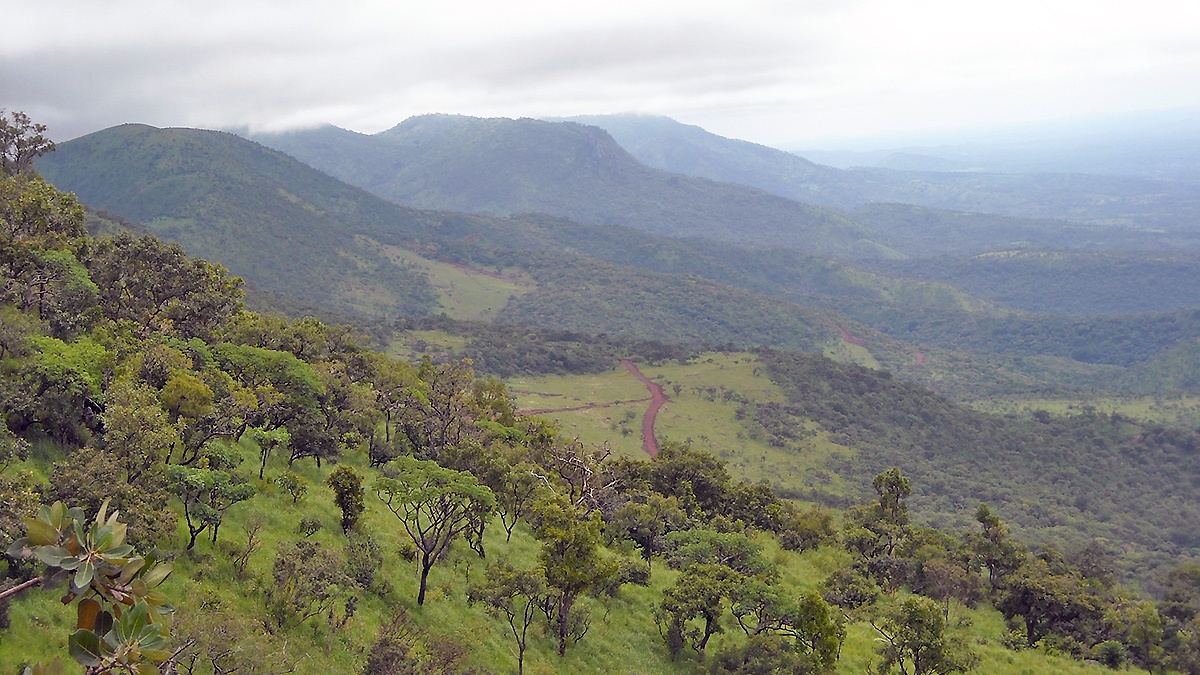
Out on the road the only bird I managed to photograph was a Blue-bellied Roller near the village of Fénédougou. As I only list birds that I can positively ID this meant that birds seen ‘on the run’ had to be distinctive enough for me to add them to the list. Those falling into this category included the likes of a flock of the nomadic Emerald Starling, Snowy-crowned Robin-Chat, Pin-tailed Whydah, Chestnut-and-black Weaver, Black-winged Red Bishop, Vieillot’s Barbet, Western Plantain-eater and Yellow-billed Shrike. As in the DRC during my field work there, I was surprised to see proteas growing on the mountain slopes in the project area.
On 1st August I transferred by road to N’Zérékoré, my base for all future trips to Guinea. In the grounds of the house here I added Olive-naped Weaver. Best sighting of three drives around the project site was my first Palm-nut Vulture, but unfortunately no photo.
![Blue-bellied Roller [Coracias cyanogaster]](https://neilswildlifejournal.uk/wp-content/gallery/coraciiformes/MG_5952_20D_Fenedougou_14Jul2009.jpg "Blue-bellied Roller [Coracias cyanogaster]")
![Blue-bellied Roller [Coracias cyanogaster]](https://neilswildlifejournal.uk/wp-content/gallery/coraciiformes/MG_5954_20D_Fenedougou_14Jul2009.jpg "Blue-bellied Roller [Coracias cyanogaster]")
![Tall Woodland Sugarbush [Protea madiensis occidentalis]](https://neilswildlifejournal.uk/wp-content/gallery/post-images-2009-2010/DSCN0564_Simandou_23072009.jpg "Tall Woodland Sugarbush [Protea madiensis occidentalis]")
![Olive-naped Weaver [Ploceus brachypterus]](https://neilswildlifejournal.uk/wp-content/gallery/post-images-2009-2010/MG_6149_20D_NZerekore_07Aug2009.jpg "Olive-naped Weaver [Ploceus brachypterus]")
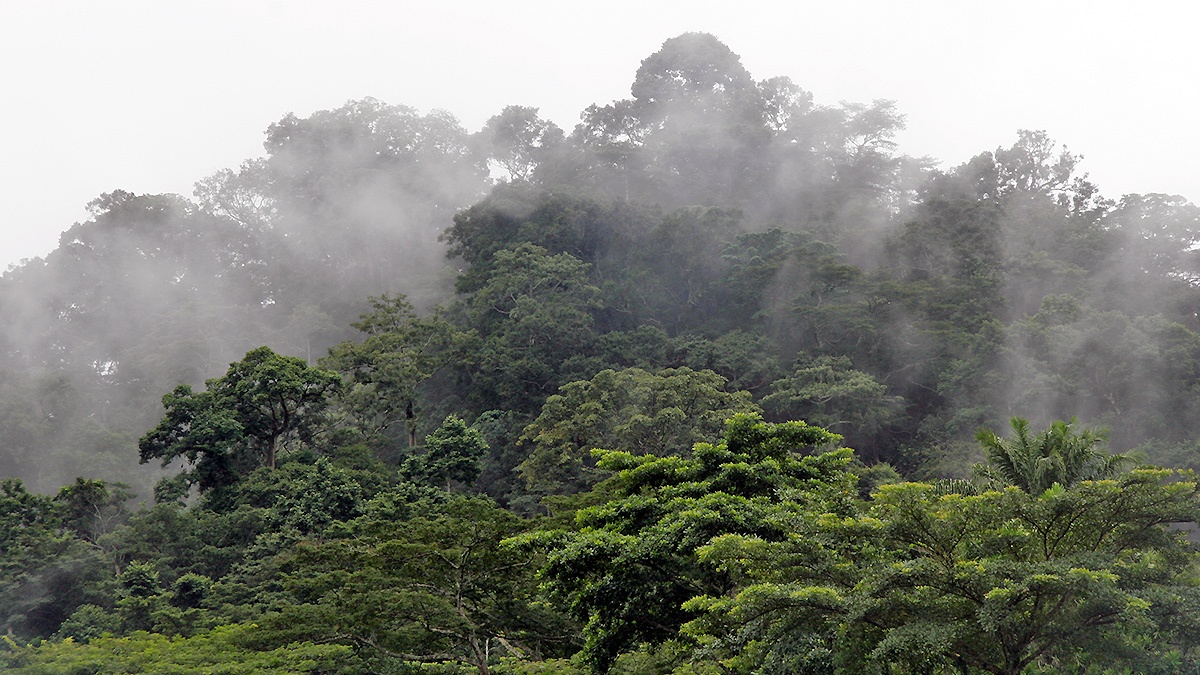
The surprise of the week in N’Zérékoré, however, was to find out that we were only 50 km by road away from the Bossou Forest Reserve, a chimpanzee sanctuary managed and monitored by, and the subject of ongoing scientific studies by Japan’s Kyoto University. Situated within 10 km of the triple junction where the borders of Guinea, Liberia and Côte d’Ivoire meet on Mount Nimba, the hope is that a ‘green corridor’ can be created between Bossou and the Mount Nimba Strict Nature Reserve, which is a protected area and UNESCO World Heritage Site located in both Guinea and Côte d’Ivoire. The bigger surprise though was that our site manager had already booked a visit to the reserve and I could put a big tick on my ‘bucket list’ as I was included.
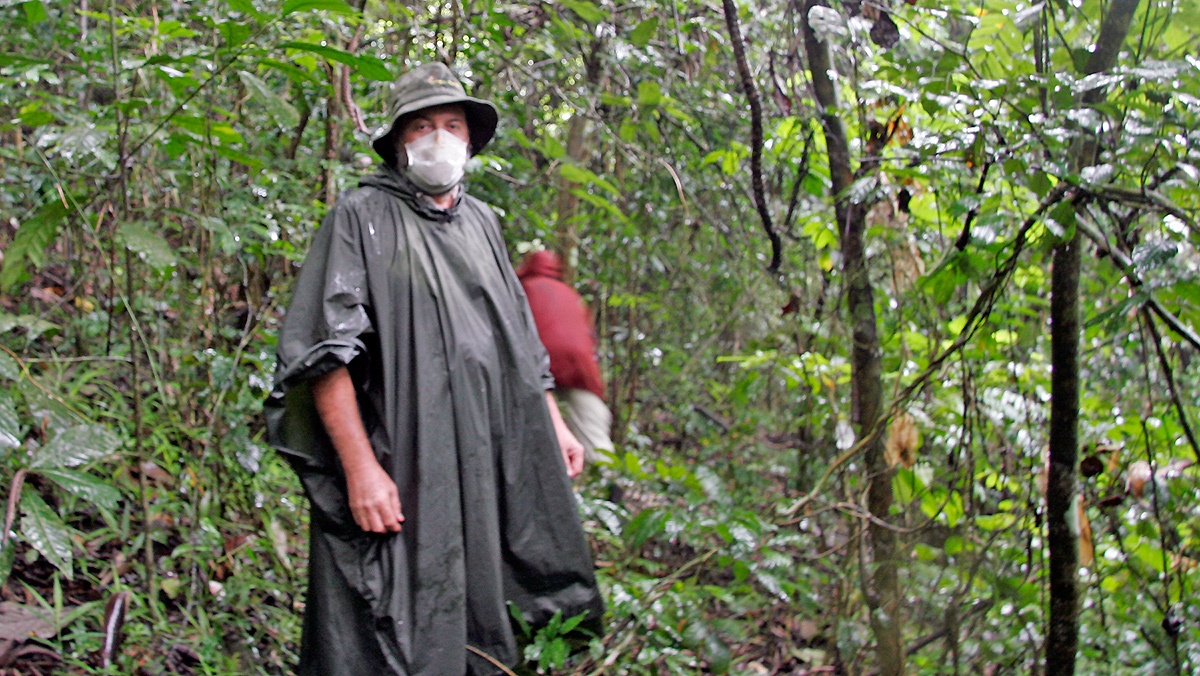
On 7th August we arrived at Bossou in heavy rain, but it eased off as we set off into what appeared to be rather impenetrable forest. We all had to wear surgical face masks to protect the chimpanzees from any human diseases that we may be carrying. So what with face masks, rain gear, high temperature and humidity, and relentless ants and other insects crawling all over us whenever we stopped it would have been a miserable morning if we did not find the chimps. What we didn’t know was that there was enough radio communication between our guides and researchers already in the forest that they had a pretty good fix on the area the troop was in. Eventually we got the signal to crouch down and remain motionless and quiet. After what seemed an age we could hear movement in the tree canopy above and then glimpses of movement through small windows in the foliage. Out came the cameras – to heck with the rain – and I did get that big tick on my bucket list. A mother clutching her youngster came lower down the tree right in front of us.
![Common Chimpanzee [Pan troglodytes verus]](https://neilswildlifejournal.uk/wp-content/gallery/post-images-2009-2010/MG_6100_20D_BossouForest_07Aug2009.jpg "Common Chimpanzee [Pan troglodytes verus]")
![Common Chimpanzee [Pan troglodytes verus]](https://neilswildlifejournal.uk/wp-content/gallery/post-images-2009-2010/MG_6102_20D_BossouForest_07Aug2009.jpg "Common Chimpanzee [Pan troglodytes verus]")
![Common Chimpanzee [Pan troglodytes verus]](https://neilswildlifejournal.uk/wp-content/gallery/primates/MG_6138_20D_Bossou_090807.jpg "Common Chimpanzee [Pan troglodytes verus]")
The following day I was transferred by road to Conakry, a marathon journey of almost 800 km involving an overnight stop in the town of Mamou, for a flight back to Johannesburg via Paris and London (to see my grand-daughter).