Atlasville, 18 Oct 2009
One doesn’t always get to make amends for a previous missed opportunity. However, on 22nd September, not 3km from where I saw my first ever Palm-nut Vulture, I got the chance to take a few shots of another (maybe even the same) Palm-nut Vulture circling low overhead as I made my way up the slopes of a mountain not too far from N’Zérékoré in Guinea. That first time, 7 weeks previously, I did not have a camera with me! This time though, out came the camera in record time – but I needn’t have worried as the vulture made several circuits before moving on.
It was actually my first time back on site in those 7 weeks as that coincided with the peak of the rainy season, when some 600-700mm rain makes field work impossible, so it’s a good time to get on top of the office work. It will be another month before we can get any heavy equipment back on site, as roads need to be graded and in places even rebuilt. It means I will be doing a lot of walking.
From a birding perspective most of my photography is confined to the grounds of our base in N’Zérékoré, as after all that rain the vegetation on site is thick and impenetrable and while lots of bird calls are to be heard the birds themselves are completely invisible. I have been able to add Red-eyed Dove, Blue-spotted Wood Dove, Village Weaver, Olive-naped Weaver, Splendid Sunbird, Magpie Mannikin and Northern Fiscal, the West African equivalent of our own Southern Fiscal.
![Magpie Mannikin [Spermestes fringilloides]](https://neilswildlifejournal.uk/wp-content/gallery/estrildidae-viduidae-prunellidae/MG_6664_20D_Nzerekore_13Oct2009.jpg "Magpie Mannikin [Spermestes fringilloides]")
![Magpie Mannikin [Spermestes fringilloides]](https://neilswildlifejournal.uk/wp-content/gallery/estrildidae-viduidae-prunellidae/MG_6576_20D_Nzerekore_07Oct2009.jpg "Magpie Mannikin [Spermestes fringilloides]")
![Northern Fiscal [Lanius humeralis smithii]](https://neilswildlifejournal.uk/wp-content/gallery/oriolidae-dicruridae-monarchidae-laniidae-corvidae-chaetopidae-ptiliogonatidae/MG_6425_20D_NZerekore_13Sep2009.jpg "Northern Fiscal [Lanius humeralis smithii]")
![Blue-spotted Wood Dove [Turtur afer]](https://neilswildlifejournal.uk/wp-content/gallery/columbiformes/MG_6473_20D_Zogota_22Sep2009.jpg "Blue-spotted Wood Dove [Turtur afer]")
![Palm-nut Vulture [Gypohierax angolensis]](https://neilswildlifejournal.uk/wp-content/gallery/accipitriformes/MG_6440_20D_Zogota_22Sep2009.jpg "Palm-nut Vulture [Gypohierax angolensis]")
![Splendid Sunbird [Cinnyris coccinigastrus]](https://neilswildlifejournal.uk/wp-content/gallery/nectariniidae/MG_6557_20D_Nzerekore_05Oct2009.jpg "Splendid Sunbird [Cinnyris coccinigastrus]")
![Olive-naped Weaver [Ploceus brachypterus]](https://neilswildlifejournal.uk/wp-content/gallery/passeridae-ploceidae/MG_6594_20D_Nzerekore_11Oct2009.jpg "Olive-naped Weaver [Ploceus brachypterus]")
![Village Weaver [Ploceus cucullatus cucullatus]](https://neilswildlifejournal.uk/wp-content/gallery/passeridae-ploceidae/MG_6501_20D_Nzerekore_03Oct2009.jpg "Village Weaver [Ploceus cucullatus cucullatus]")
![Red-eyed Dove [Streptopelia semitorquata]](https://neilswildlifejournal.uk/wp-content/gallery/post-images-2009-2010/MG_6514_20D_Nzerekore_04102009.jpg "Red-eyed Dove [Streptopelia semitorquata]")
The first few butterflies are appearing on site, but it will be another couple of months before they are out in significant numbers, something that I am looking forward to. So far I have managed images of Mother-of-Pearl, Jodutta Acraea, Blue Diadem and a caterpillar of the Two-tailed Pasha. Back at our base I found a Widow Sphinx moth outside my room door and on the wall of my room a perhaps unwelcome larva of the Household Case-bearing Moth. Out in the garden the Tree Marigold is attracting large numbers of African Honey Bee, while scuttling all over the gravelled areas of the grounds are West African Rainbow Lizard.
![Jodutta Acraea [Acraea jodutta]](https://neilswildlifejournal.uk/wp-content/gallery/butterflies-nymphalidae/MG_6451_20D_Zogota_22Sep2009.jpg "Jodutta Acraea [Acraea jodutta]")
![Western Honey Bee [Apis mellifera adansoni]](https://neilswildlifejournal.uk/wp-content/gallery/bees-wasps-sawflies-ants/DSCN0590_L16_Nzerekore_090908.jpg "Western Honey Bee [Apis mellifera adansoni]")
![West African Rainbow Lizard [Agama africana]](https://neilswildlifejournal.uk/wp-content/gallery/reptiles/MG_6693_20D_Nzerekore_13102009.jpg "West African Rainbow Lizard [Agama africana]")
![Two-tailed Pasha [Charaxes jasius]](https://neilswildlifejournal.uk/wp-content/gallery/butterflies-nymphalidae/MG_6465_20D_Zogota_22Sep2009.jpg "Two-tailed Pasha [Charaxes jasius]")
![Widow Sphinx [Acanthosphinx guessfeldtii]](https://neilswildlifejournal.uk/wp-content/gallery/moths/MG_6430_20D_NZerekore_14Sep2009.jpg "Widow Sphinx [Acanthosphinx guessfeldtii]")
![Household Case-bearing Moth [Phereoeca allutella]](https://neilswildlifejournal.uk/wp-content/gallery/moths/MG_6490_20D_NZerekore_03Oct2009.jpg "Household Case-bearing Moth [Phereoeca allutella]")
![Blue Diadem [Hypolimnas salmacis]](https://neilswildlifejournal.uk/wp-content/gallery/butterflies-nymphalidae/MG_6712_20D_Zogota_14Oct2009.jpg "Blue Diadem [Hypolimnas salmacis]")
![West African Rainbow Lizard [Agama africana]](https://neilswildlifejournal.uk/wp-content/gallery/post-images-2009-2010/MG_6693_20D_Nzerekore_13102009.jpg "West African Rainbow Lizard [Agama africana]")
![Mother-of-Pearl [Protogoniomorpha parhassus]](https://neilswildlifejournal.uk/wp-content/gallery/post-images-2009-2010/MG_6700_20D_Zogota_14Oct2009.jpg "Mother-of-Pearl [Protogoniomorpha parhassus]")
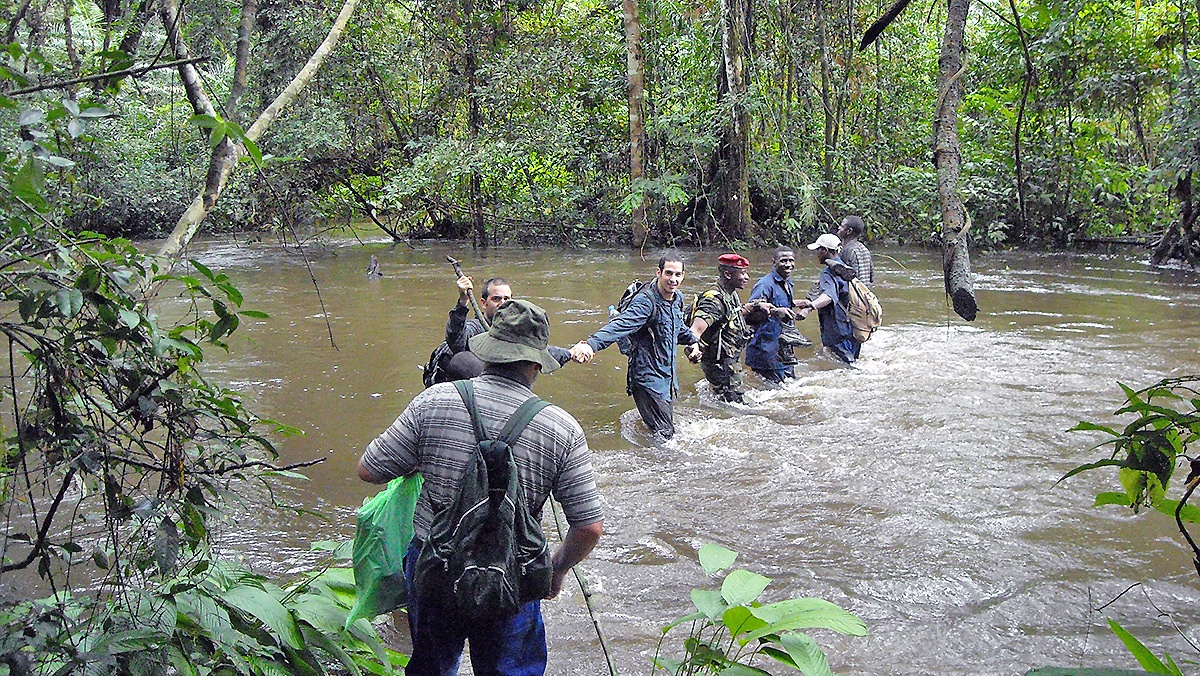
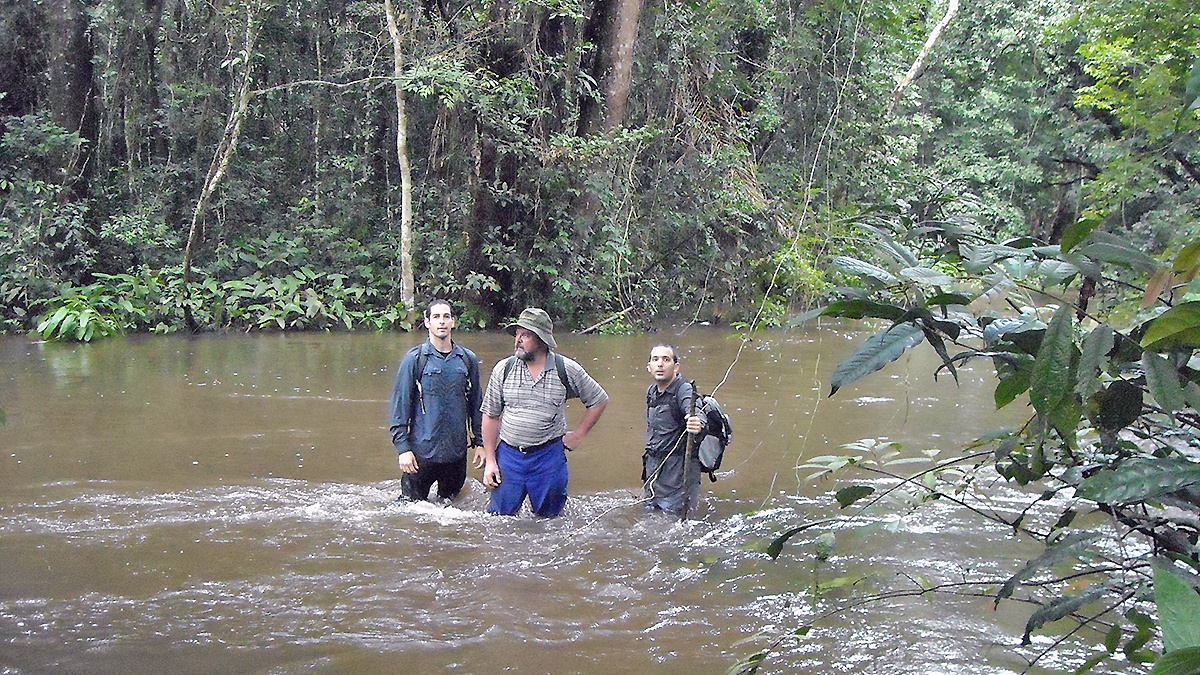
Following the success of our visit to the Bossou Reserve in August when we were able to see a troop of chimpanzees in the wild, our site manager decided we should try to see forest elephants, a sub-species of the African Elephant. [P.S. in 2021 the Forest Elephant was reclassified as Loxodonta cyclotis a species in its own right and categorised as Critically Endangered]. A small population of these forest elephants could be found in the Ziama forests just over an hour’s drive away to the west. The Ziama Massif was designated in 1980 as part of the World Network of Biosphere Reserves by UNESCO. To visit the forest we needed to apply for special passes (for a fee) and be accompanied at all times by rangers when on site. On 9th August we set off for the Ziama Forest after a night of torrential rain and meeting up with our assigned rangers were taken to an area where the elephants had been seen a few days before. We soon realised that in this very hilly area run-off from the night’s rainfall was quite extreme. Streams that were mere trickles the previous morning were now strongly flowing torrents up to 20m across. To negotiate these we had to form human chains to cross them, mainly as no-one knew precisely what was under foot and a slip or stumble would otherwise result in complete soaking. My camera equipment was consigned to thick garbage bags, where it stayed for most of the morning. We eventually abandoned our endeavours as moving around was just too difficult. All I have to show from that morning are a few photos of our stream crossings and a couple of flowers that despite the conditions were blooming in the forest. One of these flowers, the Butterfly Pea, is native to North America and introduced as an animal fodder plant but has since escaped into the wild. I also heard one very persistent bird call that I was later able to identify as belonging to the Dusky Long-tailed Cuckoo (Cercococcyx mechowi).
![Butterfly Pea [Centrosema molle]](https://neilswildlifejournal.uk/wp-content/gallery/post-images-2009-2010/DSCN0620_L16_ZiamaForest_090916.jpg "Butterfly Pea [Centrosema molle]")
![African Ginger [Siphonochilus aethiopicus]](https://neilswildlifejournal.uk/wp-content/gallery/post-images-2009-2010/DSCN0627_L16_ZiamaForest_090916.JPG "African Ginger [Siphonochilus aethiopicus]")
![African Ginger [Siphonochilus aethiopicus]](https://neilswildlifejournal.uk/wp-content/gallery/post-images-2009-2010/DSCN0628_L16_ZiamaForest_090916.jpg "African Ginger [Siphonochilus aethiopicus]")