
Atlasville, 30 Oct 2009
Another break in my Guinea work schedule and another trip to the Kruger Park. Usually visited on day trips from outside the Park, this time we stayed for the first 3 nights at Skukuza Camp for the very first time (other than a trip I had with the boys many years back when we pitched a tent on the campsite), then moved outside the Park to Crystal Springs, for the second time in as many months. Last time we used Crystal Springs Mountain Lodge as a base for day trips, but this time I got in some birding on the walking trails at the resort.
On Friday, 23rd October we set off early, so we would arrive at the Malelane Gate entrance to Kruger by midday. This would give plenty of time to make our way north to Skukuza, birding and game-viewing as we went along. Highlights were a klipspringer and a small herd of elephant along the Biyamiti Loop, and an impressive kudu bull at the Renosterkoppies waterhole.
The next day we headed west, stopping in at Lake Panic Hide, on our way to Paul Kruger Gate where we turned along the S3, a gravel road that winds along the bank of the Sabie River and which for me is one of the best birding roads in the Park. It is usually good for both Purple-crested Turaco and Striped Kingfisher and today was no exception. Returning to Skukuza I walked around the camp and managed a photo of a female Vervet Monkey with her infant, as well as Common Waxbill and Ashy Fycatcher, before heading out again in late morning. We stuck largely to the main tarred roads and completed the Skukuza-Tshokwane-Lower Sabie-Skukuza triangle, a part of the Park we are very familiar with from all our day trips into the Park via Crocodile Bridge Gate from Ngwenya Lodge. The Skukuza to Sabie River Bridge section of the Lower Sabie Road proved the most fruitful, with a rare sighting of African Cuckoo-Hawk, as well as Secretarybird and Brown-hooded Kingfisher. A photo of a male steenbok shows just how dry the conditions are, with many areas burnt during the winter months and waiting for the first sign of the summer rains.
![Purple-crested Turaco [Gallirex porphyreolophus porphyreolophus]](https://neilswildlifejournal.uk/wp-content/gallery/musophagiformes-otidiformes-cuculiformes-pterocliformes/IMG_9673_40D_SabieRiverRd_24Oct2009.jpg "Purple-crested Turaco [Gallirex porphyreolophus porphyreolophus]")
![Striped Kingfisher [Halcyon chelicuti chelicuti]](https://neilswildlifejournal.uk/wp-content/gallery/coraciiformes/IMG_9679_40D_SabieRiverRd_24Oct2009.jpg "Striped Kingfisher [Halcyon chelicuti chelicuti]")
![Common Waxbill [Estrilda astrild tenebridorsa]](https://neilswildlifejournal.uk/wp-content/gallery/estrildidae-viduidae-prunellidae/IMG_9654_40D_Skukuza_24Oct2009.jpg "Common Waxbill [Estrilda astrild tenebridorsa]")
![Vervet Monkey [Chlorocebus pygerythrus pygerythus]](https://neilswildlifejournal.uk/wp-content/gallery/primates/IMG_9727_40D_Skukuza_24Oct2009.jpg "Vervet Monkey [Chlorocebus pygerythrus pygerythus]")
![Ashy Flycatcher [Fraseria caerulescens vulturna]](https://neilswildlifejournal.uk/wp-content/gallery/turdidae-muscicapidae-cinclidae-chloropseidae-dicaeidae/IMG_9737_40D_Skukuza_24Oct2009.jpg "Ashy Flycatcher [Fraseria caerulescens vulturna]")
![Greater Kudu [Tragelaphus strepsiceros strepsiceros]](https://neilswildlifejournal.uk/wp-content/gallery/ungulates/IMG_9635_40D_Renosterkoppies_23Oct2009.jpg "Greater Kudu [Tragelaphus strepsiceros strepsiceros]")
![Klipspringer [Oreotragus oreotragus transvaalensis]](https://neilswildlifejournal.uk/wp-content/gallery/post-images-2009-2010/IMG_9595_40D_BiyamitiLoop_23Oct2009.jpg "Klipspringer [Oreotragus oreotragus transvaalensis]")
![African Bush Elephant [Loxodonta africana]](https://neilswildlifejournal.uk/wp-content/gallery/post-images-2009-2010/IMG_9613_40D_BiyamitiLoop_23Oct2009.jpg "African Bush Elephant [Loxodonta africana]")
![African Bush Elephant [Loxodonta africana]](https://neilswildlifejournal.uk/wp-content/gallery/post-images-2009-2010/IMG_9621_40D_BiyamitiLoop_23Oct2009.jpg "African Bush Elephant [Loxodonta africana]")
![Steenbok [Raphicerus campestris]](https://neilswildlifejournal.uk/wp-content/gallery/post-images-2009-2010/IMG_9702_40D_LowerSabieRd_24Oct2009.jpg "Steenbok [Raphicerus campestris]")
![African Cuckoo-hawk [Aviceda cuculoides]](https://neilswildlifejournal.uk/wp-content/gallery/post-images-2009-2010/IMG_9709_40D_LowerSabieRd_24Oct2009.jpg "African Cuckoo-hawk [Aviceda cuculoides]")
![Brown-hooded Kingfisher [Halcyon albiventris vociferans]](https://neilswildlifejournal.uk/wp-content/gallery/post-images-2009-2010/IMG_9712_40D_LowerSabieRd_24Oct2009.jpg "Brown-hooded Kingfisher [Halcyon albiventris vociferans]")
On our last full day in the Park we headed north towards Satara camp. Our first sighting of note after we had turned off the main tar road onto the gravel Nhlanguleni Road was an adult Martial Eagle perched rather precariously atop a tree on a very thin branch. As I got out of our twin-cab at the Nhlanguleni Picnic Spot I saw dozens of circling vultures overhead, so stopped to take photos before walking over to see what might be at the waterhole. Most of the vultures were of the commonest species in the Park, White-backed Vulture, but there were a couple of White-headed Vulture amongst them. The White-headed Vulture is regarded as Critically Endangered in South Africa with only an estimated 60 breeding pairs in the whole of the Kruger Park (which to put it in perspective is an area almost as big as Wales or Israel, or 2/3 the size of Belgium). The Lappet-faced Vulture is even more scarce in the Park with only an estimated 40 breeding pairs. Peripheral to the circling vultures there were also a few Bateleur.
If you asked me which animals I see most infrequently in Kruger I’d definitely put African Wild Dog and Sable Antelope well to the top of my list. Sable are usually seen singly or maybe a pair, so imagine our surprise when we looked out over the waterhole to see a herd of about 15 Sable keeping a very watchful eye on a pack of Wild Dog some 100m away. Perhaps the vultures were circling in anticipation of a kill. We watched hopefully for 10 minutes or so until three giraffe arrived at the waterhole. Their presence must have unsettled the dogs as they retreated out of sight into the bush.
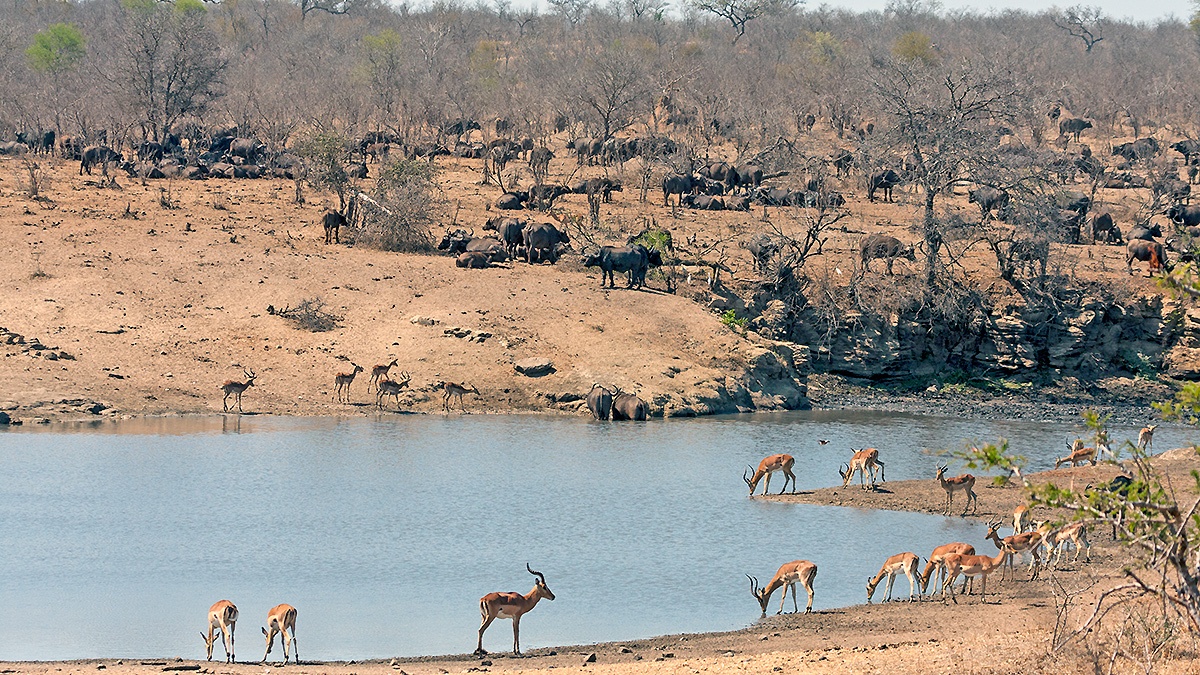
A little further north at the Shimangwaneni Dam we added another vulture to the list, this time Hooded Vulture, again in a very small minority among a good number of White-backed Vulture. One expects to see herds of animals at the waterholes at this time of year when the veld is so desperately dry. Here it was a herd of Cape Buffalo some 200 strong and impala. Also present in the thorn bushes on the edge of the dam was a small flock of Namaqua Dove that had arrived to take a drink.
We added a Purple Roller just before turning off into the Muzandzeni Picnic Spot, where we were able to see yet another White-backed Vulture in its tree-top nest with a nestling.
After making our lunch stop at Satara we headed east towards Nwanetsi along the gravel S100 road, a road that meanders along the bank of a dry (at this time of year) river bed. This has to be the ‘lion capital’ of Kruger. Over the years we have encountered many lion along this 20km stretch of road, and sometimes more than one sighting within the hour it takes to drive along it. Today was no exception, as we were treated to a pride that included several young cubs and a majestic male with a gash on his muzzle, no doubt incurred during an argument over pecking order at the pride’s latest kill.
We bypassed the Nwanetsi Picnic Spot and stopped at the Sweni Bird Hide where we added a Grey-headed Bushshrike in the bushes alongside the parking area before watching a male Waterbuck that had come to drink from the waterhole.
Most of the action today was at waterholes, so it was no surprise that we encountered elephants at the Mazithi Dam, and white rhino and buffalo at Leeupan.
We may have just missed out on the Big 5 for the day, but I reckon the Wild Dog more than made up for the missing leopard.
![White Rhinoceros [Ceratotherium simum simum]](https://neilswildlifejournal.uk/wp-content/gallery/mammals-the-big-5/IMG_9935_40D_Leeupan_25Oct2009.jpg "White Rhinoceros [Ceratotherium simum simum]")
![Sable Antelope [Hippotragus niger niger]](https://neilswildlifejournal.uk/wp-content/gallery/ungulates/IMG_9794_40D_Nhlangulene_25Oct2009.jpg "Sable Antelope [Hippotragus niger niger]")
![Sable Antelope [Hippotragus niger niger]](https://neilswildlifejournal.uk/wp-content/gallery/ungulates/IMG_9792_40D_Nhlangulene_25Oct2009.jpg "Sable Antelope [Hippotragus niger niger]")
![Sable Antelope [Hippotragus niger niger]](https://neilswildlifejournal.uk/wp-content/gallery/ungulates/IMG_9777_40D_Nhlangulene_25Oct2009.jpg "Sable Antelope [Hippotragus niger niger]")
![Waterbuck [Kobus ellipsiprymnus ellipsiprymnus]](https://neilswildlifejournal.uk/wp-content/gallery/ungulates/IMG_9867_40D_SweniHide_25Oct2009.jpg "Waterbuck [Kobus ellipsiprymnus ellipsiprymnus]")
![African Bush Elephant [Loxodonta africana]](https://neilswildlifejournal.uk/wp-content/gallery/mammals-the-big-5/IMG_9906_40D_MazithiDam_25Oct2009.jpg "African Bush Elephant [Loxodonta africana]")
![African Buffalo [Syncerus caffer caffer]](https://neilswildlifejournal.uk/wp-content/gallery/mammals-the-big-5/IMG_9939_40D_Leeupan_25Oct2009.jpg "African Buffalo [Syncerus caffer caffer]")
![Martial Eagle [Polemaetus bellicosus]](https://neilswildlifejournal.uk/wp-content/gallery/post-images-2009-2010/IMG_9751_40D_NhlanguleneRd_25Oct2009.jpg "Martial Eagle [Polemaetus bellicosus]")
![White-backed Vulture [Gyps africanus]](https://neilswildlifejournal.uk/wp-content/gallery/post-images-2009-2010/IMG_9765_40D_Nhlangulene_25Oct2009.jpg "White-backed Vulture [Gyps africanus]")
![White-headed Vulture [Trigonoceps occipitalis]](https://neilswildlifejournal.uk/wp-content/gallery/post-images-2009-2010/IMG_9787_40D_Nhlangulene_25Oct2009.jpg "White-headed Vulture [Trigonoceps occipitalis]")
![Bateleur [Terathopius ecaudatus]](https://neilswildlifejournal.uk/wp-content/gallery/post-images-2009-2010/IMG_9803_40D_Nhlangulene_25Oct2009.jpg "Bateleur [Terathopius ecaudatus]")
![Purple Roller [Coracias naevius mosambicus]](https://neilswildlifejournal.uk/wp-content/gallery/post-images-2009-2010/IMG_9810_40D_NhlanguleneRd_25Oct2009.jpg "Purple Roller [Coracias naevius mosambicus]")
![Hooded Vulture [Necrosyrtes monachus]](https://neilswildlifejournal.uk/wp-content/gallery/post-images-2009-2010/IMG_9814_40D_ShimangwaneniDam_25Oct2009.jpg "Hooded Vulture [Necrosyrtes monachus]")
![White-backed Vulture [Gyps africanus]](https://neilswildlifejournal.uk/wp-content/gallery/post-images-2009-2010/IMG_9826_40D_ShimangwaneniDam_25Oct2009.jpg "White-backed Vulture [Gyps africanus]")
![Namaqua Dove [Oena capensis capensis]](https://neilswildlifejournal.uk/wp-content/gallery/post-images-2009-2010/IMG_9830_40D_ShimangwaneniDam_25Oct2009.jpg "Namaqua Dove [Oena capensis capensis]")
![White-backed Vulture [Gyps africanus]](https://neilswildlifejournal.uk/wp-content/gallery/post-images-2009-2010/IMG_9838_40D_Muzandzeni_25Oct2009.jpg "White-backed Vulture [Gyps africanus]")
![Lion [Panthera leo melanochaita]](https://neilswildlifejournal.uk/wp-content/gallery/post-images-2009-2010/IMG_9847_40D_NwanetsiRiverRoad_25Oct2009.jpg "Lion [Panthera leo melanochaita]")
![Lion [Panthera leo melanochaita]](https://neilswildlifejournal.uk/wp-content/gallery/post-images-2009-2010/IMG_9851_40D_NwanetsiRiverRoad_25Oct2009.jpg "Lion [Panthera leo melanochaita]")
![Lion [Panthera leo melanochaita]](https://neilswildlifejournal.uk/wp-content/gallery/post-images-2009-2010/IMG_9853_40D_NwanetsiRiverRoad_25Oct2009.jpg "Lion [Panthera leo melanochaita]")
![Grey-headed Bushshrike [Malaconotus blanchoti hypopyrrhus]](https://neilswildlifejournal.uk/wp-content/gallery/post-images-2009-2010/IMG_9870_40D_SweniHide_25Oct2009.jpg "Grey-headed Bushshrike [Malaconotus blanchoti hypopyrrhus]")
On our final morning we elected to head south as far as Berg-en-Dal Camp and then head west to Pretoriuskop Camp, leaving the Park at Numbi Gate and moving on to our next accommodation at Crystal Springs.
We were hardly out of Skukuza, halfway to the Renosterkoppies waterhole, when we found our second pack of wild dogs. It may be the first time in all our years of visiting Kruger that we have seen different packs of wild dogs on consecutive days. Not long afterwards we came across an immature African Harrier-Hawk.
My only other photo of the morning was a Kurrichane Thrush at Berg-en-Dal Camp.
![African Wild Dog [Lycaon pictus pictus]](https://neilswildlifejournal.uk/wp-content/gallery/carnivores/IMG_9945_40D_S114_26Oct2009.jpg "African Wild Dog [Lycaon pictus pictus]")
![African Wild Dog [Lycaon pictus pictus]](https://neilswildlifejournal.uk/wp-content/gallery/carnivores/IMG_9967_40D_S114_26Oct2009.jpg "African Wild Dog [Lycaon pictus pictus]")
![African Harrier-Hawk [Polyboroides typus typus]](https://neilswildlifejournal.uk/wp-content/gallery/accipitriformes/IMG_9978_40D_S114_26Oct2009.jpg "African Harrier-Hawk [Polyboroides typus typus]")
![Kurrichane Thrush [Turdus libonyana libonyana]](https://neilswildlifejournal.uk/wp-content/gallery/post-images-2009-2010/IMG_9993_40D_Berg-en-Dal_26Oct2009.jpg "Kurrichane Thrush [Turdus libonyana libonyana]")
Over the next four days we had one short drive taking in all the viewpoints along the Escarpment north of Graskop. A Long-crested Eagle was spotted, inevitably sitting on a telephone pole, and a Mesic Four-Striped Grass Rat was seen at God’s Window.
For the rest of the time my wife relaxed reading while I walked the trails at Crystal Springs and one of the trails just a few kilometres away at Mount Sheba. Photos on these trails included Amethyst Sunbird, Lazy Cisticola, Cape Batis, Mocking Cliff Chat and Southern Boubou.
![Cape Batis [Batis capensis hollidayi]](https://neilswildlifejournal.uk/wp-content/gallery/platysteiridae-malaconotidae-vangidae-artamidae-aegithinidae-campephagidae-vireonidae/IMG_0012_40D_CrystalSprings_27Oct2009.jpg "Cape Batis [Batis capensis hollidayi]")
![Southern Boubou [Laniarius ferrugineus transvaalensis]](https://neilswildlifejournal.uk/wp-content/gallery/platysteiridae-malaconotidae-vangidae-artamidae-aegithinidae-campephagidae-vireonidae/IMG_0048_40D_CrystalSprings_29Oct2009.jpg "Southern Boubou [Laniarius ferrugineus transvaalensis]")
![Mesic Four-Striped Grass Rat [Rhabdomys dilectus]](https://neilswildlifejournal.uk/wp-content/gallery/other-mammals/IMG_0015_40D_GodsWindow_28Oct2009.jpg "Mesic Four-Striped Grass Rat [Rhabdomys dilectus]")
![Lazy Cisticola [Cisticola aberrans aberrans]](https://neilswildlifejournal.uk/wp-content/gallery/post-images-2009-2010/IMG_0039_40D_CrystalSprings_29Oct2009.jpg "Lazy Cisticola [Cisticola aberrans aberrans]")
![Amethyst Sunbird [Chalcomitra amethystina amethystina]](https://neilswildlifejournal.uk/wp-content/gallery/post-images-2009-2010/IMG_0052_40D_CrystalSprings_29Oct2009.jpg "Amethyst Sunbird [Chalcomitra amethystina amethystina]")
![Long-crested Eagle [Lophaetus occipitalis]](https://neilswildlifejournal.uk/wp-content/gallery/accipitriformes/IMG_0026_40D_Graskop_28Oct2009.jpg "Long-crested Eagle [Lophaetus occipitalis]")
![Mocking Cliff Chat [Thamnolaea cinnamomeiventris cinnamomeiventris]](https://neilswildlifejournal.uk/wp-content/gallery/turdidae-muscicapidae-cinclidae-chloropseidae-dicaeidae/IMG_0030_40D_CrystalSprings_29Oct2009.jpg "Mocking Cliff Chat [Thamnolaea cinnamomeiventris cinnamomeiventris]")